Record of Summit Dialogue: Disruption and Reshaping, AI Technology Empowers Enterprises to Amplify Advantages
In recent years, the country has been continuously promoting the integration of data and reality at a high level. Under the trend of data and reality integration, only by accelerating the transformation towards digitalization can we go further. The emergence of ChatGPT has enabled global users to discover the enormous potential of AI technology.
On October 27, 2023 China Enterprise Digital Transformation Summit and SIE User Conference were held in Wuhan. The conference, with the theme of "AI driven digital innovation", invited over 1000 industry elites, business leaders, experts and scholars to gather together, focusing on AI technology and creating a digital future together.
At the peak dialogue session of the main forum, Hu Haoran, the director of Xinhuanet's industrial operations and the person in charge of Spark Action, was specially invited as the host to talk with Li Peigen, an academician of the CAE Member and a professor of Huazhong University of Science and Technology, Zhang Chengkang, the chairman and CEO of SIE Information, Wan Xuchang, president of Sunrise Oriental Holdings Co., Ltd., and Zhang Chuanzong, the founder and CEO of 49th Square, to explore the challenges and opportunities in the era of the big model, centering on "subversion and remodeling, and AI technology empowering enterprises to enlarge their advantages".
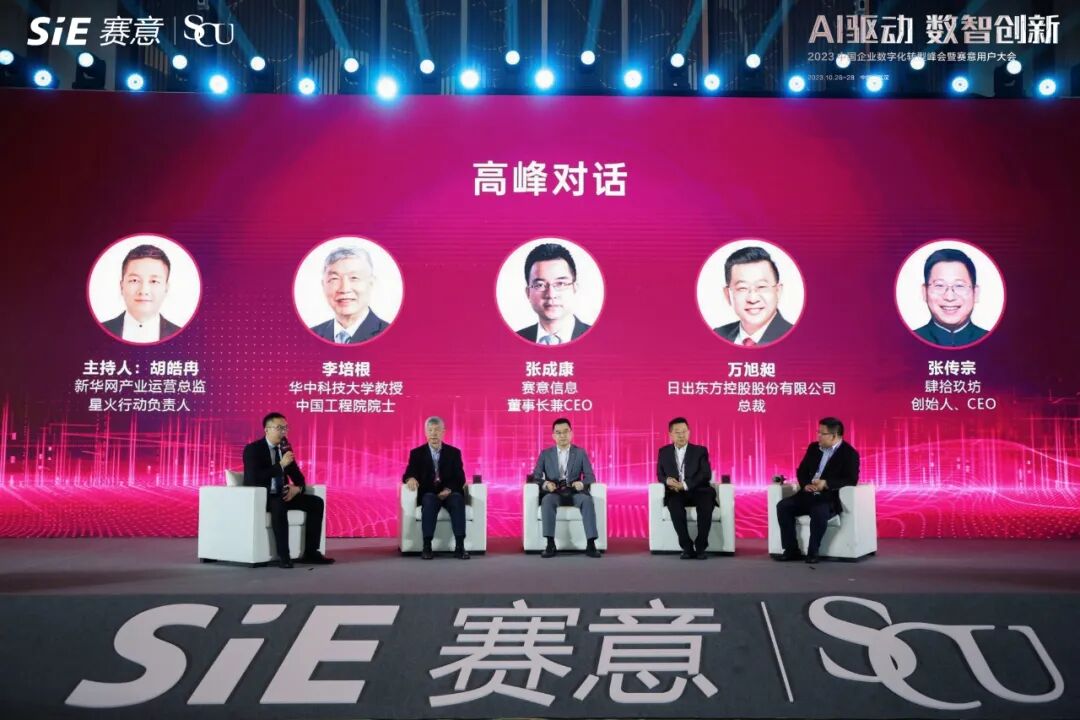
At the conference, the focus was on the topic of "difficulties encountered in using AI empowerment in the process of enterprise digital transformation", and interactive topic voting was also specially set up. Guests in the audience scanned codes to participate in the interaction, and the voting results were presented in real time on the big screen. In depth discussions were conducted around common problems, and suggestions and references were jointly explored to help enterprises improve their digital transformation.
The following is a transcript of some exciting content from the peak dialogue session:
In the era of big models, at what stage has China's AI technology been applied in the field of digital transformation?Li Peigen:At present, it is still in the early stage of artificial intelligence application, and the manufacturing industry is a blue ocean for artificial intelligence application. The penetration rate of AI technology application is still low, and it has not fully exerted its full potential. The application potential still needs to be developed. Of course, the emergence of large models can greatly promote the implementation of AI applications, but in recent years, it has not yet reached a disruptive level. I tend to use the word 'surpassing' to describe it. Nowadays, everyone is talking about high-quality development, but it is very difficult for a company to continue to surpass a little bit at a high-quality level. Artificial intelligence technology may help companies achieve further improvement and surpassing, enhancing efficiency and innovation capabilities. What enterprises currently need is to integrate AI technology with their business, implement it to solve practical business pain points, and maximize value.
The big model industry will enter the era of "Hundred Model Wars". How do you view this scorching big model competition?Zhang Chengkang:In the era of big models, generative AI is a major trend, and the current development status requires more than value. The massive investment in manpower, resources, and funds is driving the development and application of technology. At this point, we need to address the input-output problem: how to make AI generate value? In the application of exploring scenarios, the core problem to be solved is actually the issue of input and output. For example, training a model requires a large knowledge base and a large amount of computing power. The resulting benefits may save little cost for a single factory or enterprise, but it may not be the case for an industry. Just like the 'scissors gap principle' I talked about, when all intelligence is significantly lower than the cost of using traditional models in the future, it will be completely replaced when this intersection point comes. At present, SIE has also worked with customers in the PCB industry to create industrial application scenarios. Through large model training in the field of process automation, the accuracy can be improved by up to 90%. When it can reach 100% or 99.9% in the future, we can replace it. Although this intersection has not yet arrived, in such a big wave, each of us should actively learn and embrace AI technology.
As a leading enterprise in the comprehensive application of clean energy, what have we done in the field of artificial intelligence and industrial integration for Sunrise East?Wan Xuchang:I believe that on the path of digitization, we need to recognize ourselves and stay grounded in the present. As a traditional enterprise, Sunrise Oriental is also grasping digital transformation and actively exploring new models of digital management, achieving certain results. For example, it is committed to data governance, effectively breaking through the "information island", and completed the launch of six major systems in the field of intelligent manufacturing in just three months, including "manufacturing, warehousing, quality, data acquisition, equipment, and procurement". At present, the application of AI in the digital transformation of traditional manufacturing has also been gradually carried out, and is in the pilot and partial application stage. In the wave of new technologies, I believe that enterprises need to be based on the present, recognize themselves, find the path that suits them, follow but not follow the trend. Only what is suitable is the most beautiful, and can help enterprises achieve healthy and sustainable development in the long run.
Under the new consumption concept, how did SixJiuFang break through its boundaries in exploring the combination of its own business and digitalization? What experiences can you share with us?Zhang Chuanzong:With the continuous development of AIGC technology, traditional distilleries have begun to introduce some intelligent equipment and systems to improve production efficiency and quality. AI has been rapidly applied in the liquor industry. With AI empowerment, only two people are needed to manage a thousand person factory, achieving highly automated "black light production". The new AI technology can play a huge role in the warehousing, logistics, manufacturing, and supply chain scenarios of liquor enterprises. Through data analysis and prediction, it can optimize supply chain management, improve the operational efficiency of the supply chain, help enterprises achieve improved operational efficiency, and ultimately achieve the effect of cost reduction and efficiency improvement.
How do you view "disruption" and "reshaping" in the era of AI?Li Peigen:It is difficult for us to talk about "disruption" in the near future. In the industrial metaverse, there will be some disruptive changes in products, business models, consumption patterns, and so on. This is possible, but such changes are still relatively distant at present. Reshaping "refers to how to empower enterprises with digital technology for transformation. Digital transformation is multifaceted, and the transformation of product development, manufacturing, service, and other models is a process of reshaping.
Zhang Chengkang:The innovation of technology is rapidly iterating, and AI has disruptive power in the manufacturing industry. Automation, robots, and AI are changing traditional production lines, moving from traditional manufacturing to intelligent manufacturing. This is the subversion of scenarios. When the intersection comes, it is not optimization but replacement and subversion. So we need to embrace AI and discover this big trend. As a digital service provider, in the AI era, SIE has also joined hands with Huawei and its customers. With the knowledge how we have accumulated in the industry for many years, we have deeply touched the core pain points of the industry, created industry models, and constantly penetrated the industry, thus subverting the traditional production and manufacturing model and enabling high-quality development of enterprises.
Wan Xuchang:The changes in technology are constantly evolving and gradually changing our habits and ways of life. For example, with the advent of office software, we can directly use mobile devices such as DingTalk to approve files. Taking Sunrise East as an example, our air source heat pump products saw a 99% year-on-year increase in sales revenue from the first to third quarters of this year. Faced with such a huge demand for goods, we would not have been able to achieve smooth supply without the introduction of digital technology. These are tangible changes brought about by digitization and intelligence, and we need to quickly keep up and adapt to the reshaping of enterprise scenarios by new technologies.
Zhang Chuanzong:In 2010, Lenovo launched its first generation smartphone, the LePhone. At that time, smartphones were thick and heavy, and the range of intelligence was very limited. We couldn't imagine that today's smartphones were so small and lightweight, and could almost solve all your problems. The rapid development of mobile Internet and e-commerce live broadcasting in recent years has made human-computer interaction and human interaction possible. The emergence of ChatGPT has brought new possibilities, and in the future, we can achieve super creativity at ultra-low cost through the powerful execution of artificial intelligence. I believe that AI can bring disruptive changes in the future.
According to the results of the recent voting interaction, many people believe that in the process of empowering thousands of industries with AI and in the digital transformation of enterprises, the issues of "organizational change, talent matching, difficulty in finding scenarios, and data security" are of great concern. What is your opinion on this?Li Peigen:At present, there are many intelligent and digital tools available, and the emergence of low code and zero code has made it more convenient and efficient for our business personnel to use them. We need to build a good digital ecosystem to collaboratively create value and achieve a synergistic effect of 1+1>2. Over time, these issues can gradually be resolved.
Zhang Chengkang:The implementation of AI applications in enterprises first depends on whether the leaders of the enterprise embrace AI and initiate change. Change initiatives must be initiated from top to bottom to achieve consistent goals for all employees. Next is talent. For enterprises, people are the most crucial link, and they need to build a learning organization. Furthermore, when it comes to scenarios, as a digital service provider, we need to consider how to improve efficiency internally and how to create new value externally. Finally, information security is a concern for many companies. Companies can choose to privatize or collaborate with platforms that have government endorsement and credibility.
Wan Xuchang:For most companies, talent is never enough, and for change, I strongly agree with what Mr. Zhang said about initiating change from top to bottom. The top leader of a company should have the courage to learn and change, find suitable benchmarks, study and learn from the experiences of leaders, and then find opportunities to surpass them. Business owners should base themselves on the current situation, boldly confirm the scenarios you are using, identify which ones need to be changed and which ones do not, and take advantage of the situation to find relevant talents to achieve your dreams.
Zhang Chuanzong:I see that this scene is difficult to find and ranks third, but I have a slightly different opinion. I think the scene is not difficult to find, and I believe that there are always scenarios that can be replaced and optimized by AI everywhere. Recently, we have produced a new product with a yield rate of only 30%. If there is better technology to support it in the future and increase this data to 50% or 80%, it will be a very visible improvement in benefits. Today, there are already many successful cases of intelligent manufacturing in the industry, and we are also building and planning our factories, hoping to redefine future oriented business through digital means. President Zhang of SIE also mentioned the intersection of the "scissors difference principle". I think this intersection is coming or has come.